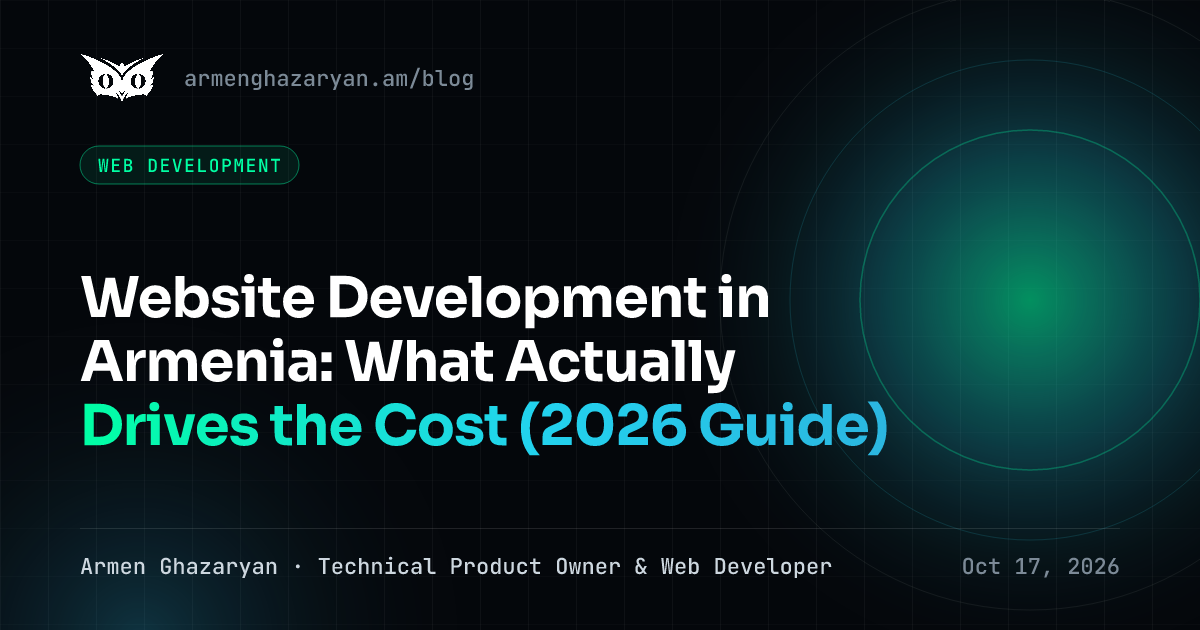
Website Development in Armenia: What Actually Drives the Cost (2026 Guide)
A web developer's honest guide to website development costs in Armenia — what changes the price of a landing page, business site, online store or web app, and how to get an accurate quote.

"How much does a website cost?" is the first question almost every business in Armenia asks me — and the honest answer is "it depends" until we've talked for ten minutes. That's not a dodge. Two sites that look similar on the surface can differ in effort by a factor of ten.
I've built websites and web apps for 50+ clients since 2022, so instead of throwing out a number that won't fit your project, here's what actually moves the price — and how to get a quote you can trust.
1. What kind of website you actually need
The single biggest factor is the type of project:
- Landing page — one page, one goal (calls, sign-ups, bookings). Fastest to build.
- Business website — several pages: services, about, contact, maybe a blog. Most companies in Yerevan start here.
- Online store — products, cart, checkout, payments, delivery options, stock. Much more logic and testing.
- Web application — anything with user accounts, dashboards, subscriptions or custom workflows. This is software, not a website, and it's priced like software.
Be honest about which one you need today. A great business site that launches in a few weeks usually beats an ambitious platform that's still "almost ready" six months later.
2. Template or custom design
A well-chosen template can be adapted quickly. A custom design — your brand, your layout, your interactions — takes design time plus build time. Custom makes sense when your website is your product or your main sales channel. For a new business that mostly needs to look credible on Google Maps and Instagram, a polished template is often the smarter spend.
3. Languages: Armenian, Russian, English
This one is specific to Armenia and often underestimated. Many businesses here need the site in Armenian, Russian and English. Each language means:
- translated and proofread content (not machine-translated menus),
- layouts that survive longer Russian words and Armenian script,
- separate URLs and proper language tags so Google shows the right version to the right visitor.
A trilingual site isn't three times the work, but it's meaningfully more than one language.
4. Payments, bookings and other integrations
Every integration adds work and testing:
- Online payments — card processing through a payment provider, receipts, failure handling. On Epilepsy.am attendee registration included integrated online payments.
- Bookings and scheduling — available slots, confirmations, reminders. Kesoyan.am exists so clients can book consultations without back-and-forth.
- CRM and email marketing — sending leads and customers into the tools you already use.
- Delivery, stock, accounting — common for online stores.
5. An admin panel you can actually use
Who updates the site after launch? If the answer is "us, every week," you need a content-management system or a custom admin panel. Hasmik's Club, a membership platform I built, is backed by a strong admin panel because the team manages members, events and an e-book library themselves. That's real scope — but it's what stops you paying a developer for every text change.
6. SEO, speed and analytics
A website nobody finds is a cost, not an asset. Basic technical SEO — clean HTML, page titles and descriptions, a sitemap, fast loading on mobile, Google Search Console — should be part of any professional build. Content strategy and ongoing SEO are a separate, ongoing piece of work.
7. Hosting, domain and maintenance
Budget for the parts after launch: the domain (for example a .am domain), hosting, SSL, backups, security updates and small fixes. Ask whether maintenance is included, billed hourly, or not offered at all.
How to get an accurate quote
Send your developer a short brief with:
- What the website must achieve (leads, sales, bookings, credibility).
- The pages or features you need — and which ones can wait for version two.
- Languages.
- Integrations: payments, booking, CRM, delivery.
- Who will update content after launch.
- Two or three websites you like, and why.
- Your deadline and a rough budget range.
That last point matters. A budget range isn't a trap — it lets a good developer tell you what's realistic and where to save.
Want a quote for your project?
I'm Armen Ghazaryan, a web developer and Technical Product Owner from Armenia. If you're planning a website or web app, get in touch with a short brief and I'll tell you honestly what it takes. You can also read more about me and my work.